Van Gogh's Sunflowers at the National Gallery, London
National Gallery Sunflowers: how London got its Van Gogh, how it differs from Amsterdam's, and free visiting details.

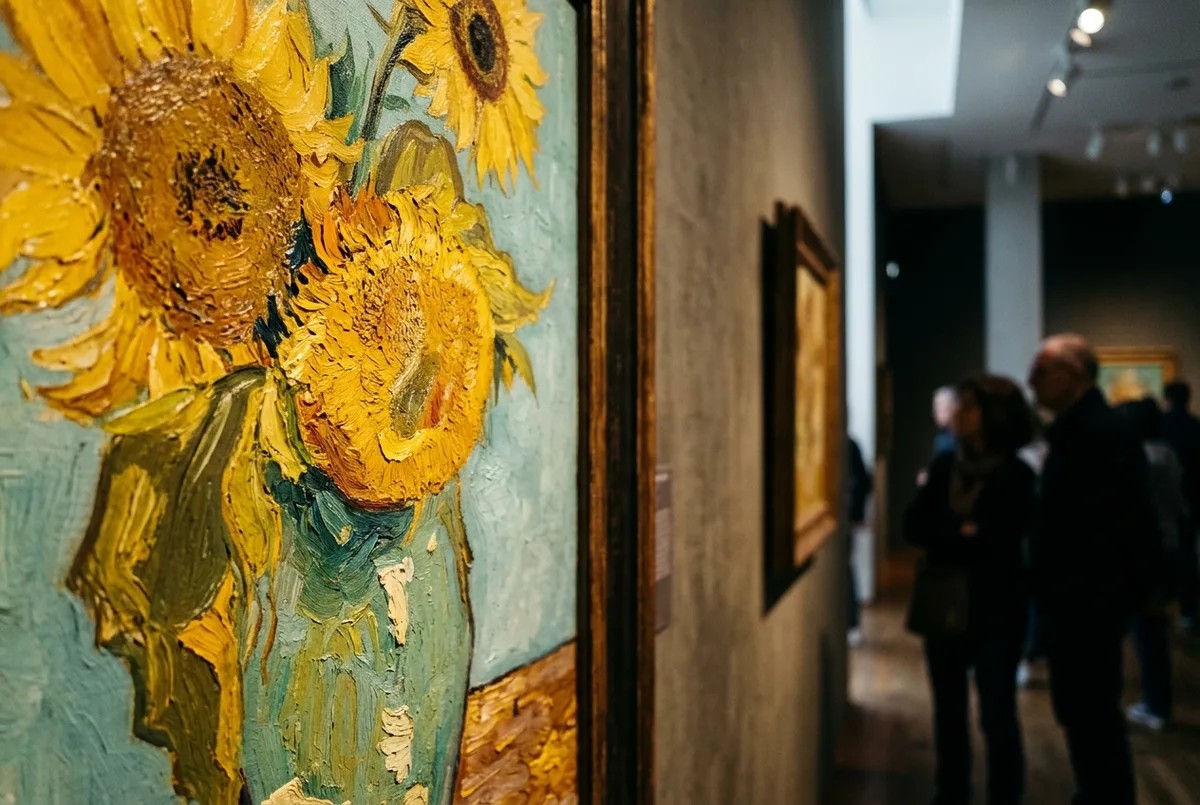
The National Gallery sunflower painting is the fourth Arles canvas, painted in August 1888 and bought from Van Gogh's family in 1924. It is a different painting from either Sunflowers in Amsterdam, and it's free to see.
 Van Gogh Museum Admission Ticket: Price and Entry Times From $29.62 · Cheapest way in See dates
On this page 8 sections
The National Gallery sunflower painting is the fourth canvas of Van Gogh’s Arles series, painted in August 1888. One of five Sunflowers versions on public display worldwide, and a genuinely different painting from either of the two sitting in Amsterdam.
The London Sunflowers by the numbers
Source:National Gallery, London“The sunflower is mine.”
National Gallery, London · source
Is Van Gogh’s Sunflowers really at the National Gallery in London?
Yes, it is. One of the five public Sunflowers canvases hangs at the National Gallery in Trafalgar Square: a vase of fifteen sunflowers Van Gogh painted in August 1888, bought directly from the artist’s family.
Easy to assume every “Sunflowers” you’ve seen in photos is the same canvas. It isn’t. This one measures 92.1 by 73 cm, oil on canvas — a specific, physical object that’s hung in London since the 1920s and hasn’t gone anywhere since.
How did the National Gallery get this Van Gogh painting?
The Gallery’s Trustees wanted Van Gogh represented in London by one signature work. So they used the Courtauld Fund, set up for buying modern paintings, and persuaded the artist’s family to sell it directly to the Gallery in 1924.
That same fund bought three other major Van Gogh works during the 1920s, all from the South of France period. Which is why London’s small Van Gogh holding clusters around that one productive stretch of his life rather than spreading across his whole career.
Is entry to see Van Gogh’s Sunflowers free?
Yes. General admission to the National Gallery is free, with donations welcome; only a handful of special exhibitions charge. The main free entrance is the Sainsbury Wing, facing Trafalgar Square, open daily from 10am to 6pm and until 9pm on Fridays.
Build in a little slack either way. The Gallery is enormous, and even a quick trip aimed at one painting goes smoother with an unhurried hour than a tight ten minutes between trains.
Where exactly is Sunflowers hanging inside the gallery?
No fixed room to rely on right now, honestly. Building work ahead of a new Research Centre, opening in 2028, means some paintings are temporarily moved, and the Gallery itself tells visitors to check its website or floorplan before visiting rather than trust an old room number.
Say you turn up expecting the painting in the room a friend described from their trip two years back. Not there? Don’t panic and assume it left London. Check the current floorplan at the information desk first — a move inside the building is far more likely than a loan abroad.
Where are the other Van Gogh Sunflowers paintings?
Besides London, public versions hang at the Van Gogh Museum in Amsterdam, the Neue Pinakothek in Munich, the Philadelphia Museum of Art and the Sompo Museum of Art in Tokyo. One more sits in a private collection, and a sixth was destroyed in a 1945 air raid on Ashiya, Japan — gone, for good. The full Sunflowers series guide breaks down all seven versions in order.
| Version | Painted | Where it is today |
|---|---|---|
| London | August 1888 | National Gallery, London |
| Amsterdam (bouquet) | January 1889 | Van Gogh Museum, Amsterdam |
| Amsterdam (small study) | 1887 | Van Gogh Museum, Amsterdam |
| Munich | August 1888 | Neue Pinakothek, Munich |
| Philadelphia | January 1889 | Philadelphia Museum of Art |
| Tokyo | January 1889 | Sompo Museum of Art, Tokyo |
| Private collection | August 1888 | Not on public display |
How is the London Sunflowers different from the Amsterdam version?
London holds the original August 1888 fourth canvas. Amsterdam holds two different paintings: a January 1889 repetition of the same bouquet, and a small 1887 study of cut flowers lying on the ground.
The two have hung side by side before. The National Gallery’s own account of a 2014 display describes lending Amsterdam’s Sunflowers to London to mark the two museums’ long friendship. If you’ve genuinely seen “the same painting” in both cities at different points in your life, that’s the reason — close siblings from the same series, not two copies of one canvas.
How much is Van Gogh’s Sunflowers worth?
No price exists for any of the five museum versions. None is for sale, full stop. A different, privately owned Sunflowers canvas sold for the equivalent of nearly $40 million at a 1987 Christie’s auction in London — a record at the time — but that one isn’t among the five public collection pieces.
For the full collection back in Amsterdam, including Almond Blossom and The Potato Eaters, see the Van Gogh Museum collection guide. And if your travels take you past the Met, the Orsay or the Louvre, the guide to where else to see Van Gogh’s paintings covers what each actually holds.
Questions
What was Van Gogh’s only sold painting?
Van Gogh sold very few works in his lifetime, and the one most often cited as his confirmed sale is The Red Vineyard, bought in 1890 — not any version of Sunflowers.
What is the most famous picture in the National Gallery?
The National Gallery holds plenty of famous works across eight centuries, and opinions vary, obviously, but Sunflowers is consistently named among its best-known pieces, right up there with Turner and Leonardo da Vinci.
What are the top 10 paintings at the National Gallery?
No official top 10 exists; the collection spans thousands of works. Sunflowers, though, is a near-constant fixture on visitor and critic lists of the Gallery’s highlights.
What disability did Vincent van Gogh have?
He lived with serious mental illness for much of his adult life. Historians still debate the exact diagnosis — bipolar disorder is one proposed explanation, while an early diagnosis of epilepsy is now largely dismissed by modern researchers.